





The silverado 1500 vs 2500 comparison is not a question of quality. Both trucks carry Chevrolet’s standard for reliability and engineering precision. The real question is whether the job you are asking the truck to do fits within the 1500’s engineering ceiling, or whether your demands push past it. Understanding where that line sits, and why it exists, gives you the clarity to make an informed decision before you step onto a lot.
What the Class Difference Actually Means
Half-ton and three-quarter-ton are legacy terms. They no longer describe literal weight. Instead, they describe engineering classification, and that classification defines the entire mechanical foundation of each truck.
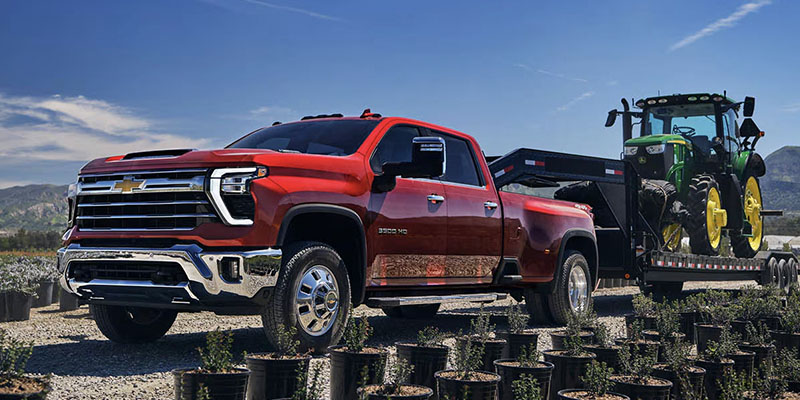
The Silverado 1500 is a half-ton truck. Its frame, suspension, axles, and drivetrain are built for a specific load and towing ceiling. The Silverado 2500 HD is a three-quarter-ton truck. Every structural component underneath it handles greater stress across more demanding load cycles.
These classifications carry real mechanical consequences. The 2500 HD runs a heavier-gauge, fully boxed steel frame throughout its entire length. The 1500 uses a mixed design that transitions between boxed and C-channel sections. Under sustained towing load, frame rigidity controls how much twist and flex the structure absorbs. A stiffer frame transfers load more predictably to the hitch. That is why the 2500 HD’s towing ceiling sits nearly double that of the 1500. The 1500 is rated to approximately 13,300 pounds. The 2500 HD reaches up to 22,420 pounds when equipped with the diesel engine and a fifth-wheel hitch setup.
Axle Specification
The rear axle specification also changes completely between the two trucks. The 2500 HD carries a Dana 60 rear axle. The 1500 uses a lighter-duty axle matched to its rated load range. The Dana 60 is a larger, heavier unit built for sustained torque delivery and higher gross axle weight ratings. Shoppers who plan to tow frequently, or near the top of their rated capacity, need to recognize that axle spec is part of what makes that rating sustainable over time.
How Frame and Suspension Architecture Separates These Trucks
The suspension design between these two trucks is fundamentally different. That difference shows up in two situations: under load, and when the truck runs empty.
The 1500 uses an independent front suspension and a coil-spring rear setup. This architecture prioritizes ride quality and handling response. It works well for daily commuting, light hauling, and towing within its rated range. The 2500 HD uses a solid front axle with coil springs and a multi-leaf rear spring pack. That rear leaf spring setup carries far more weight in the bed without squatting or losing stability.
Furthermore, the leaf spring arrangement on the 2500 HD keeps the truck at a more level stance under heavy payload. When a half-ton truck loads to or near its payload limit, the rear suspension compresses significantly. That compression affects steering geometry, braking distance, and trailer tongue weight management. The 2500 HD’s stiffer rear pack resists that compression by design. Shoppers who haul heavy materials in the bed regularly, not just on a hitch, need to factor this into the comparison.
Brake Hardware Scaling
The front Dana 60 axle on the 2500 HD also supports a larger brake package. Heavier-duty rotors and calipers pair with it at the factory. Stopping a loaded truck is a physics problem, not just a horsepower problem. More mass requires more brake surface area to control deceleration safely. The 1500’s brake hardware correctly matches its rated load range. However, it does not handle the stopping demands of a 20,000-pound combined load. That is why the 2500 HD’s entire brake system scales up accordingly.
Towing vs Payload: Two Different Measurements
These two numbers are frequently treated as interchangeable. They are not. Towing capacity and payload capacity measure two completely different loads, and confusing them is one of the most common mistakes in the truck-buying process.
Towing capacity is the maximum weight the truck can pull behind it on a trailer. The truck’s frame strength, hitch rating, engine torque output, transmission capability, and cooling system design all govern this number. The Silverado 2500 HD’s towing ceiling reflects all of those systems working together at their rated limits.
Payload capacity is the maximum weight the truck can carry inside itself. That includes cargo in the bed, passengers, gear, and any tongue weight the trailer places on the hitch ball. Gross Vehicle Weight Rating governs payload. Exceeding payload capacity stresses the suspension, frame, and tires beyond their design limits. It also removes certain warranty coverage and creates legal liability in commercial applications.
Consider what this means for a shopper comparing the two trucks:
- The Silverado 1500 carries a payload rating in the range of 1,500 to 2,200 pounds depending on configuration, which covers most recreational and light work scenarios comfortably.
- The Silverado 2500 HD reaches a payload rating of approximately 3,979 pounds in its highest-rated configuration, supporting contractors, landscapers, and anyone moving bulk materials on a regular schedule.
- Tongue weight from a heavy trailer counts against payload, so shoppers towing near the 1500’s towing ceiling may also approach their payload limit through tongue weight alone.
Evaluating both numbers together, rather than separately, produces a configuration that works safely and within spec.
Engine Options and Why Torque Drives the Difference
The Silverado 2500 HD offers two engine choices. The standard engine is a 6.6-liter gas V8 producing 401 horsepower and 464 lb-ft of torque. The available engine is a 6.6-liter Duramax turbo-diesel V8 producing 470 horsepower and 975 lb-ft of torque. That torque figure is the number that matters most when the truck is pulling weight.
Horsepower describes how fast an engine does work. Torque describes the rotational force available to move weight. When a trailer is heavy, the drivetrain needs torque to break inertia, maintain speed on grades, and control deceleration through engine braking. The Duramax produces more than twice the torque of a typical gas engine in this class. Drivers feel that gap the moment the truck encounters a long uphill grade with 18,000 pounds behind it.
The Allison Transmission Connection
Chevrolet pairs the Duramax exclusively with the Allison 10-speed automatic transmission. The Allison is not a standard passenger-vehicle transmission adapted for heavy use. Engineers built it specifically around sustained commercial load cycles. Its torque capacity rating exceeds what most standard automatic transmissions in light-duty trucks handle. Shoppers who tow frequently and at high weights should treat the diesel and Allison pairing as a system, not simply as an engine upgrade.
The gas V8 is not a compromise for shoppers whose loads fall well within the 2500 HD’s range. For occasional heavy towing, construction site use, or fifth-wheel setups that stay below 14,000 pounds, the gas engine delivers a capable and lower-cost configuration. The diesel becomes the clear choice when the load is heavy, the route is long, and the towing frequency is high.
What the 2500 HD Adds Beyond the Numbers
Several features come standard on the Silverado 2500 HD that the 1500 does not include. These additions reflect the engineering requirements of heavier towing, not trim-level upgrades.
The integrated trailer brake controller ships as standard equipment on the 2500 HD. This controller communicates with electric trailer brakes and applies them proportionally during deceleration. Most states require a trailer brake controller for any trailer weighing more than 3,000 pounds. Beyond legal compliance, the system coordinates trailer brake engagement with the truck’s own braking. Without that coordination, a heavy trailer pushes the truck forward during hard stops, which increases stopping distance and reduces driver control. The 1500 offers this feature as an add-on in certain trims, but the 2500 HD includes it by default because loads at this weight class require it.
Additionally, the 2500 HD is available with a factory-installed gooseneck hitch prep package and fifth-wheel prep package. These packages include reinforced bed floor mounting points and wiring provisions. Shoppers who plan to tow horse trailers, equipment trailers, or large fifth-wheel recreational vehicles need these mounting points rated correctly from the factory. Factory prep means the hitch mounting integrates into the frame’s load path by design.
Consider the additional features that separate the 2500 HD’s towing setup from the 1500:
- The factory trailer brake controller on the 2500 HD responds proportionally to deceleration rate, so light stops produce light trailer brake application and hard stops produce firmer engagement automatically.
- The available Duramax engine includes an exhaust brake system that uses intake restriction to slow the truck during downhill descent without applying the friction brakes, which reduces brake heat and extends pad life on long grades.
- The 2500 HD’s cooling system is sized for sustained load, with a larger radiator and transmission cooler than the 1500 carries, which matters on long towing routes in high ambient temperatures.
These additions are not convenience upgrades. They are engineering responses to the load demands this truck is rated to handle.
How the 2500 HD Rides When You Are Not Hauling
What does it actually mean to drive a Silverado 2500 HD on an ordinary day, without a trailer attached and without weight in the bed? This is a question worth answering directly, because the ride character of a heavy-duty truck genuinely differs from a half-ton.
The multi-leaf rear suspension on the 2500 HD tunes for load. When the bed runs empty, that stiffness is fully present. The rear end feels firmer than a 1500 over road imperfections, speed bumps, and uneven pavement. This is not a flaw. It is the mechanical trade-off for a suspension system that does not compress under 3,900 pounds of payload. Shoppers who have never driven a heavy-duty truck should take an extended test drive over varied roads before deciding.
However, the front suspension on the 2500 HD delivers a more composed ride than many shoppers expect. The solid front axle with coil springs absorbs road input well at highway speed. Steering is accurate and direct. The cab structure on the Silverado 2500 HD provides strong insulation, and noise levels at highway speed compete with the 1500 across most trim comparisons.
Fuel economy is the other consideration that shoppers should weigh honestly. The gas 2500 HD carries an EPA rating in the range of 13 to 16 mpg combined depending on configuration. The Duramax diesel improves on that range and delivers better fuel efficiency under towing load, because the diesel engine does not work as hard proportionally when pulling heavy weight. The 1500 achieves 16 to 23 mpg combined depending on engine and drivetrain choice. Shoppers who do not need the 2500 HD’s load capacity should weigh this gap carefully. For those who do need the capacity, the fuel economy trade-off is the cost of the engineering required to produce it, and the diesel configuration narrows that gap considerably when the truck spends most of its miles under load.


