





The question of who needs a heavy duty truck is a load-and-use decision, not a preference decision. The Silverado 2500 HD is not the right truck for every driver. However, for drivers whose work, hauling schedules, or trailer weights push past the half-ton ceiling, it is the truck that handles those demands by design. Knowing where that line sits, and whether your actual use crosses it, is the most useful place to start.
The Load Threshold That Defines the Need
The Silverado 1500 is a capable truck. It tows up to approximately 13,300 pounds, carries a payload of up to 2,200 pounds, and handles the demands of most recreational and light work scenarios without issue. The 2500 HD becomes the right choice when loads consistently push against or above those numbers.
A useful way to frame this: the 1500 is engineered to operate within its rated ceiling across its service life. A truck that regularly runs at 90 to 100 percent of its towing or payload rating is not operating with meaningful headroom. Transmissions, cooling systems, and braking hardware all carry thermal and mechanical stress ratings. Sustained near-limit operation accelerates wear on those systems faster than the same truck used at 60 to 70 percent of its capacity.
The 2500 HD shifts that entire equation. Its towing ceiling reaches 22,420 pounds with the Duramax diesel and the right hitch configuration. Its highest payload rating reaches approximately 3,979 pounds. A driver towing 14,000 pounds with a 2500 HD is operating at roughly 62 percent of the truck’s rated ceiling. That same load on a 1500 exceeds the truck’s rated limit entirely.
Why Headroom Matters
Operating with capacity headroom is not about using capability for its own sake. It is about keeping the truck’s drivetrain, transmission, and cooling systems in their intended stress range. The Duramax diesel paired with the Allison 10-speed transmission is built around sustained commercial load cycles. The gas 6.6-liter V8 on the 2500 HD carries the same frame and suspension advantage even without the diesel’s torque output. Both configurations give drivers room to work without pushing the truck to its limits on every trip.
Work Scenarios That Push Past the Half-Ton Ceiling
Certain professions and job site demands routinely produce loads that exceed what a half-ton truck handles within spec. Contractors hauling gravel, sand, or construction materials in the bed move weight that compounds quickly. A cubic yard of wet concrete weighs approximately 4,000 pounds. A loaded equipment trailer carrying a skid steer or compact excavator commonly reaches 14,000 to 18,000 pounds. Landscapers running mulch, soil, or stone deliveries regularly load their beds near or above what the 1500 is rated to carry.
Furthermore, plumbers, electricians, and HVAC technicians who outfit their trucks with service bodies, tool storage systems, and material loads often find that the combined weight of equipment and supplies approaches the 1500’s payload ceiling before they add a single piece of job site cargo. The 2500 HD gives those drivers the payload range to run a fully outfitted work setup without trimming their load to stay within spec.
Consider the work categories where the 2500 HD earns its place:
- Contractors and site operators hauling heavy equipment on trailers rated between 14,000 and 20,000 pounds need the 2500 HD’s towing ceiling and factory trailer brake controller to stay within safe and legal operating parameters.
- Trade professionals running heavy service body upfits, tool storage, and material loads need the payload rating headroom the 2500 HD provides over a loaded half-ton configuration.
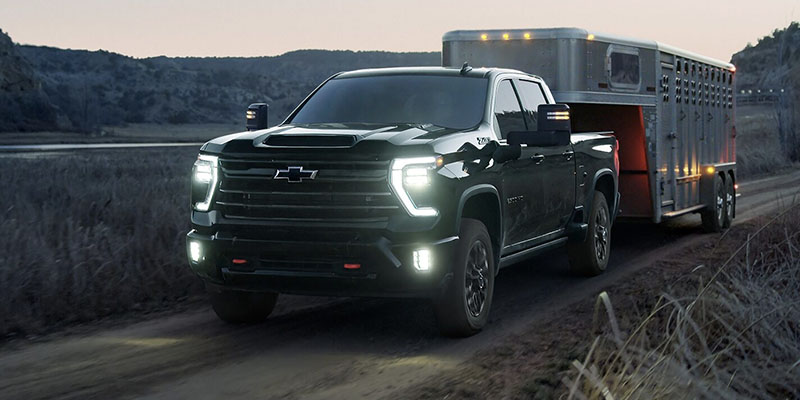
- Agricultural operators moving livestock trailers, feed deliveries, or farm equipment between locations regularly carry weights that exceed the 1500’s rated limits across both towing and payload categories.
These are not edge cases. They are the core use scenarios the 2500 HD addresses by design.
Fifth-Wheel and Gooseneck Towing as a Distinct Category
Fifth-wheel and gooseneck trailers introduce a load dynamic that standard bumper-pull towing does not. Both hitch types transfer a portion of the trailer’s total weight directly onto the truck’s bed. That transferred weight is called pin weight on a fifth-wheel and tongue weight on a gooseneck. It counts against the truck’s payload rating, not its towing rating.
A large fifth-wheel recreational trailer weighing 18,000 pounds total commonly carries a pin weight of 3,600 to 4,500 pounds. That pin weight sits entirely on the truck’s bed and counts against its payload capacity. The 1500’s payload ceiling does not accommodate that load. The 2500 HD’s payload rating, combined with its reinforced bed floor mounting points from the factory fifth-wheel prep package, handles that pin weight within spec and keeps the trailer connection integrated into the truck’s frame load path.
Gooseneck hitch setups follow the same logic. Horse trailer operators, livestock haulers, and equipment transporters who use gooseneck connections carry tongue weights that regularly reach 2,500 to 3,500 pounds. Beyond that, consider the full trailer weights involved:
- A two-horse slant trailer with horses loaded commonly weighs 8,000 to 10,000 pounds total, which sits within the 1500’s towing range but carries a tongue weight that may challenge its payload ceiling in a fully loaded configuration.
- A four-horse or six-horse trailer with tack, feed, and horses loaded reaches 14,000 to 20,000 pounds, which moves entirely outside the 1500’s rated range and into territory where the 2500 HD is the appropriate platform.
- Equipment trailers carrying two pieces of compact machinery, landscaping equipment, or commercial vehicles routinely reach 16,000 to 22,000 pounds, which requires the full towing ceiling the 2500 HD provides.
Shoppers in these categories should evaluate both their total trailer weight and their expected pin or tongue weight before selecting a truck configuration.
Recreational Towing and When Size Starts to Matter
Recreational towing is where the decision becomes less obvious. Many buyers considering the 2500 HD for camping, boating, or travel trailer use genuinely wonder whether their loads justify the step up. The answer depends on what they are towing and how often.
A large fifth-wheel recreational vehicle in the 38 to 42-foot range commonly weighs between 15,000 and 20,000 pounds loaded. That range exceeds the 1500’s ceiling and places the load squarely in the 2500 HD’s operating range. A mid-size travel trailer in the 8,000 to 10,000-pound range sits within what a well-configured 1500 handles. The distinction is not about the type of trip. It is about the weight on the hitch.
Boat towing follows a similar pattern. A center console or cabin cruiser on a heavy trailer can reach 10,000 to 14,000 pounds. A 1500 handles the lower end of that range within spec. However, a driver who regularly loads near 13,000 pounds is operating with minimal headroom on a truck that is not built for sustained near-limit use. The 2500 HD absorbs that load with room to spare and does so without stressing the drivetrain on every trip to the water.
What Ownership Looks Like When the Truck Is Not Working
A heavy-duty truck is not a specialty vehicle that drivers park until they need to tow. For most owners, the 2500 HD is the primary vehicle. It handles school runs, grocery trips, and highway commutes alongside the job site and trailer work. Understanding what that daily use feels like matters before committing to the purchase.
The rear suspension on the 2500 HD is stiffer than a half-ton. Drivers notice this most on rough pavement, gravel roads, and speed bumps when the bed is empty. The truck is not punishing to drive daily, but it does not absorb road imperfections the way a 1500 does. Drivers who have never owned a heavy-duty pickup should spend time behind the wheel in real driving conditions, not just a parking lot loop, before deciding.
Fuel economy runs in the range of 13 to 16 mpg combined on the gas 6.6-liter V8. The Duramax diesel returns better numbers, and its advantage grows considerably when the truck is under load. Drivers who cover long commutes between towing jobs may find the diesel’s fuel efficiency advantage narrows the operating cost gap over time. The 1500 returns 16 to 23 mpg combined depending on configuration, so the fuel economy gap is real and worth calculating against actual mileage patterns.
The cab on the Silverado 2500 HD is well-insulated and comfortable across all major trim levels. Road noise at highway speed is well-managed. The available technology suite, including the large center display, available digital rearview mirror, and trailer camera system, makes the truck genuinely easier to manage day to day. Drivers who need a heavy-duty platform do not give up meaningful comfort to get the capability they require.


