




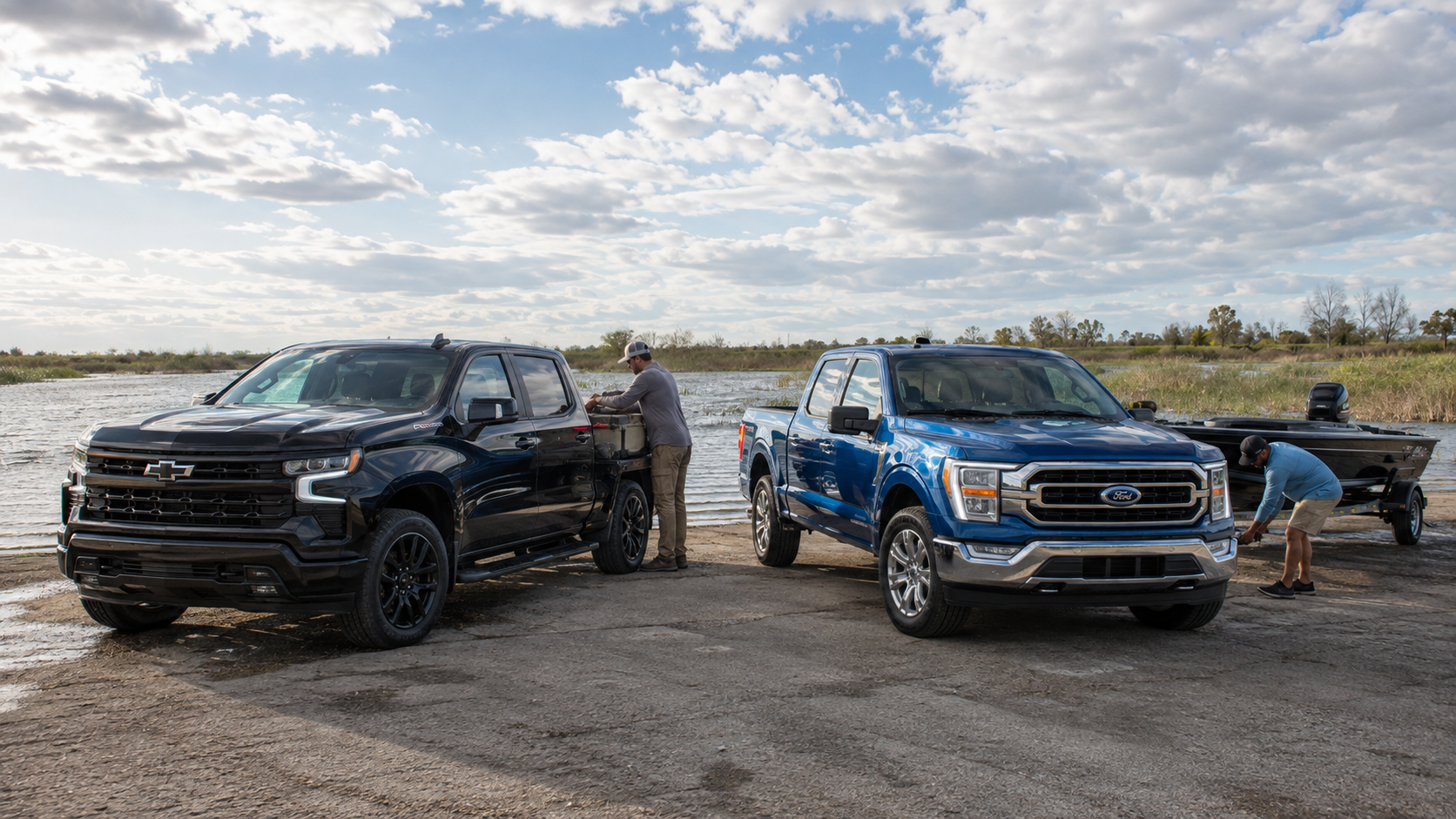
Silverado 1500 vs F150 comparisons make more sense when you match each truck to the jobs you expect. In addition, Louisiana truck owners may tow boats, utility trailers, campers, or equipment across the same week. Therefore, headline ratings alone do not tell the whole story. Furthermore, engine choice, cab layout, bed length, drivetrain, and trailering equipment all change what each truck can handle. The strongest comparison starts with the exact setup you plan to buy.
Does the F150 Tow More Than the Silverado 1500?
Maximum towing is a setup specific rating, not a number that applies to every truck. Still, Ford lists a higher maximum figure for the F150. Chevrolet lists a slightly lower maximum for the Silverado 1500. However, that small gap only applies to trucks equipped to reach those published limits.
With that in mind, ask one question first. Will the truck on the lot match the setup behind the maximum number? The answer requires checking engine, cab, bed, drivetrain, axle equipment, and trailering packages. Therefore, two trucks wearing the same badge can carry very different tow ratings.
Moreover, the Silverado 1500 can reach 13,300 pounds in an approved setup. Ford lists up to 13,500 pounds for the F150 with specific equipment. That 200 pound difference sounds simple, yet it does not settle the comparison by itself. Instead, compare the exact trucks you are considering against the trailer you plan to pull.
Towing and Payload Measure Different Loads
In addition, towing measures the trailer weight the truck can pull. Payload measures weight carried by the truck itself. That includes passengers, cargo, installed equipment, and trailer tongue weight. Therefore, both numbers deserve attention before you connect a trailer.
Should towing or payload matter more for your setup? You need both, because a trailer can stay within one limit while pushing another too far. Tongue weight transfers part of the trailer load onto the truck. In addition, people and cargo inside the cab or bed also count toward payload.
Consequently, setup checks matter more than a single maximum figure. A crew cab with passengers, tools, and towing gear may have less remaining payload than an empty truck. Likewise, a heavier trailer can add more tongue weight to the rear axle. For this reason, compare the truck's door label and trailering information with the loaded trailer you expect to use.
Compare Diesel, Turbo Gas, V8, and Hybrid Choices
Furthermore, engine choice changes how the Silverado 1500 vs F150 comparison feels under load. Chevrolet offers TurboMax, two V8 choices, and the 3.0L Duramax diesel. Ford offers turbocharged V6 choices, a V8, and the PowerBoost full hybrid. Each layout reaches torque through a different mechanical path.
For this reason, the Duramax uses diesel combustion and turbocharging to produce strong low speed torque. That can suit owners who spend substantial time towing or covering longer highway distances. By contrast, Ford's EcoBoost engines use turbochargers with gasoline power to build strong torque from smaller displacement.
Ford also offers PowerBoost hybrid assistance. Its electric motor works with the gasoline engine and can supply onboard electrical power. Chevrolet does not offer a full hybrid Silverado 1500 in the current lineup. Therefore, shoppers who specifically want hybrid propulsion will find that choice on the Ford side.
Before choosing an engine, compare these points:
- Check torque output where you expect to use it, not only peak horsepower.
- Match engine selection to trailer weight, annual mileage, and fuel preference.
- Review drivetrain and trailering package requirements for the exact rating you need.
Which Truck Gives You More Bed Space?
Furthermore, cargo volume measures the usable three dimensional space inside the bed. Bed length only measures one part of that area. Chevrolet publishes 62.9 cubic feet for its short bed and 71.7 for its standard bed. Its long bed reaches 89.1 cubic feet.
Why does that matter for tools, coolers, and outdoor gear? Wider and deeper bed dimensions can create more usable space even when floor lengths look similar. Therefore, bed volume deserves attention beside the length printed on a specification sheet.
Moreover, Chevrolet's comparison data gives the Silverado larger published cargo volume across corresponding bed categories. That can matter for owners carrying bulky equipment or several storage bins. Still, usable space should match the items you carry most. A longer bed may suit lumber or equipment. By contrast, a shorter box can be easier to place in tighter parking areas.
In addition, bed access and cargo organization should be part of the comparison. Tie downs, bed steps, tailgate features, covers, and storage accessories can change how useful the space feels. Compare those details on the exact trim and box length you plan to use.
Compare Trailering Technology by Task
In addition, trailering technology works best when you match each feature to a specific towing task. Some tools assist while hitching. Others support trailer monitoring, reversing, or highway travel. Therefore, a longer feature list does not automatically make one truck the stronger fit.
Which towing technology would you use most? Start with the part of towing that gives you the most work. Ford offers tools such as Pro Trailer Hitch Assist and Pro Trailer Backup Assist on eligible F150 setups. Chevrolet offers camera based trailering tools and available Super Cruise with trailering on select Silverado setups.
Hitching assistance focuses on aligning the truck with the coupler. Backup support focuses on trailer movement while reversing. Highway assistance serves a different purpose once the trailer is already connected. For this reason, compare technology by task instead of counting features.
A boat owner who connects a trailer every weekend may value hitch positioning tools. Someone who spends long hours on compatible highways may care more about available highway assistance. In addition, owners who back trailers into campsites or driveways may value reversing support more.
Compare Price Against the Truck You Need
Still, starting price gives you a useful entry point, but it does not describe the truck you may buy. Engine choice, drivetrain, cab, bed, trim, trailering equipment, and technology can move the final price quickly. Therefore, the Silverado 1500 vs F150 decision should compare similar builds.
Start by listing the equipment your truck must have. Then compare matching setups from both brands. This prevents a base truck from being compared against a heavily equipped alternative.
A useful final checklist includes:
- Confirm the cab and bed layout you need for passengers and cargo.
- Verify towing and payload ratings for the exact setup.
- Compare engine, drivetrain, trailering equipment, and technology on similar builds.